How to Transition a Farm to Sustainable & Regenerative Agriculture
Moving toward sustainable and regenerative agriculture does not mean abandoning productivity, eliminating every agricultural input, or changing an entire farm overnight.
A successful transition should improve the long-term health of the soil and farming system while protecting production, crop quality and the financial viability of the farm.
At The Green Van, we approach regenerative agriculture as a gradual process. Every farm is different, so the transition begins by understanding the existing operation before deciding what should change.
Start With an Assessment of the Existing Farm
Before introducing new practices, it is important to understand how the farm currently functions.
This includes evaluating the soil, irrigation water, crop health, fertilization program, pesticide use, irrigation system, weeds, drainage, machinery, labor, waste streams and production history.
Soil and water testing are particularly important. Problems such as high pH, salinity, poor drainage, low organic matter or unsuitable irrigation water cannot be solved simply by adding compost or changing fertilizer.
The objective is to identify what is already working, what is creating problems and where improvements will have the greatest impact.
Improve the Soil Before Trying to Replace Everything Else
Healthy soil is one of the foundations of regenerative agriculture.
Depending on the farm, improvement may include:
Compost and other organic amendments
Cover crops and green manures
Mulching
Reduced unnecessary tillage
Crop rotation
Returning suitable crop residues to the soil
Increasing biological activity
Correcting drainage and compaction
These practices should be introduced according to the actual condition of the soil rather than following a standard recipe.
Reduce Synthetic Fertilizers Gradually
One of the biggest mistakes during a transition is suddenly eliminating fertilizers that crops have depended on for years.
Instead, fertilizer use can be progressively optimized as soil fertility and nutrient cycling improve.
Soil testing, plant observations and, where appropriate, tissue analysis can help determine what the crop actually requires. Compost, organic fertilizers, cover crops and recycled farm nutrients can then replace part of the external fertilizer requirement.
The objective is not simply to use fewer inputs. It is to use nutrients more efficiently while maintaining production.
Move Toward Integrated Pest & Disease Management
Regenerative farming does not mean ignoring pests and diseases.
The first objective should be prevention.
Crop rotation, resistant varieties, proper irrigation, plant nutrition, greenhouse hygiene, pruning, airflow, beneficial organisms, insect traps, physical barriers and biological products can significantly reduce pest and disease pressure.
Chemical intervention, when required, should become more targeted and based on monitoring rather than routine spraying.
Keep the Soil Covered
Bare agricultural soil is vulnerable to erosion, moisture loss, temperature extremes and declining biological activity.
Depending on the production system, soil can be protected using cover crops, living groundcovers, mulch or crop residues.
In orchards and vineyards especially, properly managed cover crops can become an important part of the farming system rather than treating every plant between the trees as a weed.
Turn Farm Waste Into Resources
A regenerative farm should increasingly recycle the resources it already produces.
Animal manure, pruning residues, crop waste and other suitable organic materials can potentially be converted into compost, mulch, biogas and fertilizer instead of becoming disposal problems.
Integrating these systems can reduce waste while decreasing dependence on externally purchased inputs.
Increase Diversity Where It Makes Sense
Diversity can improve resilience, but it should have a purpose.
Crop rotations, intercropping, flowering plants, hedgerows, cover crops and integration of livestock can support soil health, beneficial insects and more resilient production systems.
However, commercial farms still need efficient operations.
Regenerative design should therefore balance biodiversity with machinery access, labor efficiency, irrigation, harvesting and commercial production requirements.
Measure the Results
A transition should be monitored like any other agricultural investment.
Useful indicators can include:
Yield • Crop quality • Fertilizer consumption • Pesticide use • Irrigation requirements • Soil organic matter • Soil structure • Labor requirements • Production costs • Farm profitability
This allows the farmer to determine which changes are actually improving the operation and which need adjustment.
Regenerative Agriculture Is a Transition, Not a Formula
There is no single regenerative agriculture system that can simply be copied from one farm to another.
A vineyard in the mountains, a vegetable farm, an avocado orchard, a greenhouse operation and a livestock farm all require different approaches.
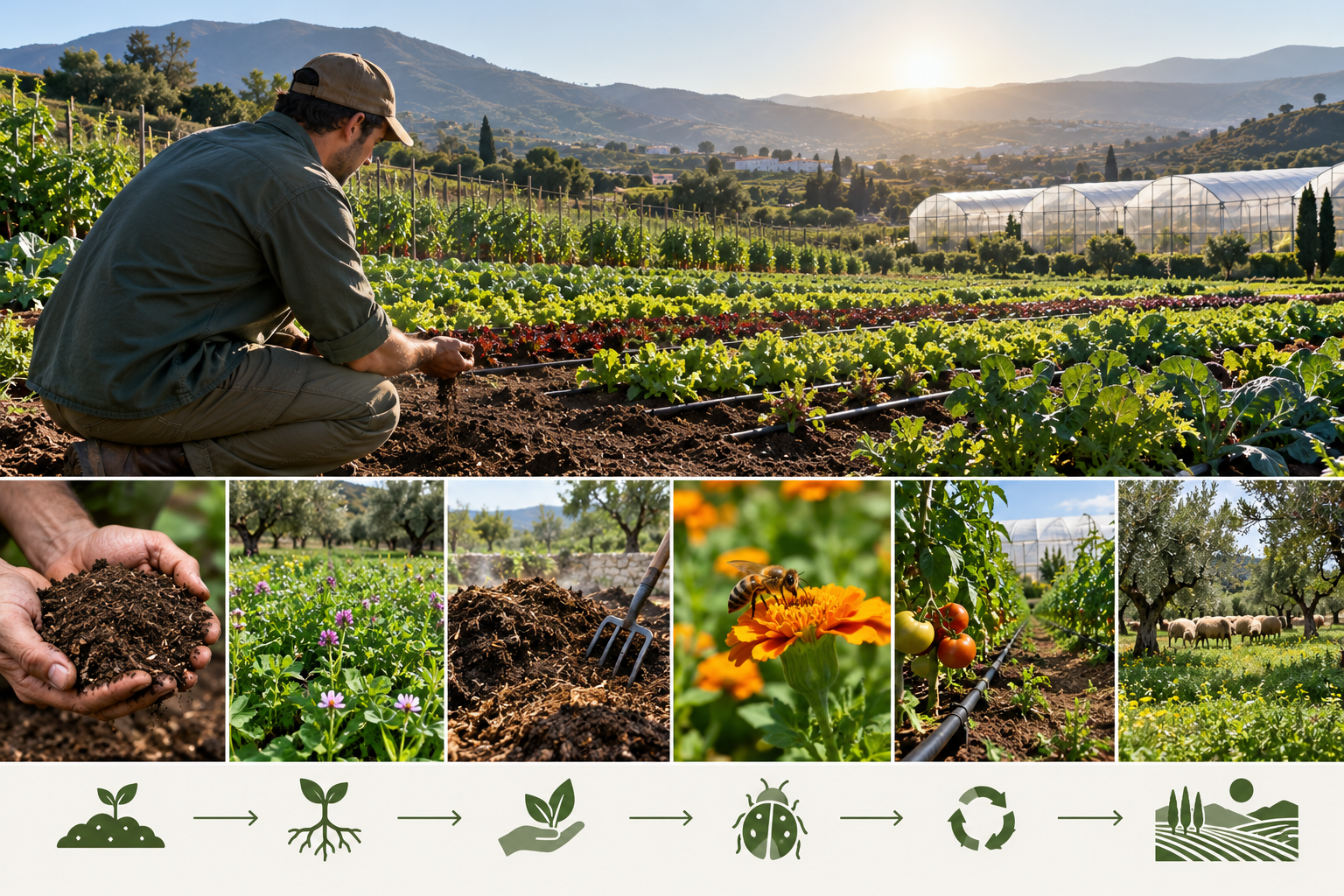
The most successful transition is usually progressive and measurable: improve the soil, reduce unnecessary inputs, recycle resources, increase biological diversity where practical, introduce appropriate technology and continuously evaluate the effect on production and profitability.
For The Green Van, sustainable and regenerative agriculture is not about choosing between environmental responsibility and commercial agriculture.
The objective is to develop farming systems capable of achieving both.
Need Help Transitioning an Existing Farm?
The Green Van provides agricultural assessment, consultancy and farm-management services for farms looking to improve productivity while progressively introducing sustainable and regenerative practices.
FAQ:
Can a conventional farm transition to regenerative agriculture gradually?
Yes. In most commercial farms, a gradual transition is preferable because changes can be monitored while maintaining production and controlling financial risk.
Do regenerative farms have to stop using synthetic fertilizers immediately?
No. Fertilizer use can be progressively optimized as soil fertility, organic matter and nutrient cycling improve.
Can regenerative agriculture work on commercial farms?
Yes. The system should be designed around production, operational and financial requirements rather than treating regenerative practices separately from commercial farming.
Contact The Green Van
+961 (70) 155040